Machine Learning-Accelerated Screening of Hydroquinone Analogs for Proton-Coupled Electron Transfer
About
This is the first iteration of Project EQUUS (Effective QUest into boUnded chemical Spaces). It is an ultrafast screening workflow for redox-active organic small molecules, particularly diamines, for their applications in catalysis and redox mediation. Using AIMNet2 and AIMNet2-NSE, we have virtually screened over 0.5 million small molecules for their bond dissociation free energy (BDFE), which is one of the most important parameters in understanding and exploring the chemistry of these molecules. As a result of this work, we have discovered several new patterns in our dataset. We believe this tool will now allow chemists to have an idea of the thermodynamic landscape of their reaction before it even happens!
A subset (0.018%) of molecules studied in this work
What is BDFE?
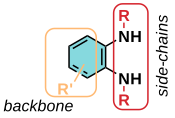
Bond Dissociation Free Energy (BDFE) is essentially the energy required to homolytically break a bond between two atoms. This work focuses on measuring the (average) BDFE of redox-active molecules involving two N-H, O-H and S-H bonds, vicinal to each other. Most of our work focuses on phenylenediamines, because of several reasons — they are highly relevant as ligands in organometallic reactions and there is a significant gap in information about this family of molecules (compared to C-H, O-H and S-H). This can potentially open new avenues of research.

How to measure BDFE?
- Go to the Calculation page and draw your molecule(s) or paste its SMILES string(s). If you do not have access to this page, it is probably because you are either not logged in or something is broken (we really hope this is not the case). But do not worry — please reach out to any of the folks at the bottom of this page and they will help you out.
- In the calculation page, draw a redox-active molecule and click the Predict button to get an estimation for the average BDFE. We have restricted the type of molecules that you can submit for prediction to vicinal diamines, diols and dithiols, for now.
- If you want to calculate the average BDFE of your molecule(s) with near-DFT precision you will need to draw the entire dehydrogenation reaction. Keep the default settings and click the Calculate button to get your results. You could also test out individual steps in the workflow at this stage.
- Once your calculations are done, you can view your results by visiting the My Results page.
- You can explore the results we got from our explorations by using the interactive plots on the Equus Results page. While you are exploring, check out the PES Visualizer to see the potential energy surface of a PCET reaction.